
Crowsnest
Pass, Alberta
Frank Slide - The Day the Mountain Fell
July 26, 2003
| Back | Return to Index Page |
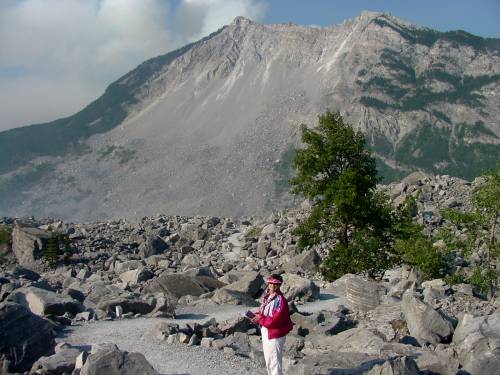
All of this rock came from the notch in the mountain in the background.
|
On April 29, 1903, at 4:10 a.m., 82 million tonnes (30 million cubic
metres) of limestone crashed from the summit of Turtle Mountain and
buried a portion of the sleeping town of Frank. The dimensions of the
rock mass that fell are 150 metres (500 feet) deep, 425 metres (1,400
feet) high and one kilometre (3,280 feet) wide. The primary cause of the Frank Slide was the mountain's unstable structure. Underground coal mining, water action in summit cracks and severe weather conditions may have contributed to the disaster. The mechanism of movement that enabled the rockslide-avalanche to spread over 3 square kilometres (1.2 square miles) of the valley in less than 100 seconds, has been the subject of considerable discussion and speculation. The debris may have remained in contact with the surface through most of its course, flowing down the side of the mountain and across the valley. Or, lubrication at the base of the slide, compressed air or steam, would permit sliding of a flexible sheet of debris. The buried section of railway was rebuilt 3 weeks after the slide. A road was completed through the slide in 1906 and improved during the 1920s. Before it was completed, people had to travel over a rough road built beyond the rockslide debris. This temporary route passed through what is now the Frank Slide Interpretive Centre parking lot and the Frank Slide Trail follows the old road bed for some distance. Highway #3, as it is seen today, was constructed in the 1930s and improved in 1979. |


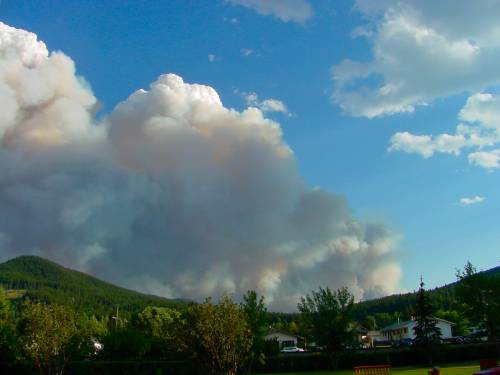
The fires are following us!
| Back | Return to Index Page |